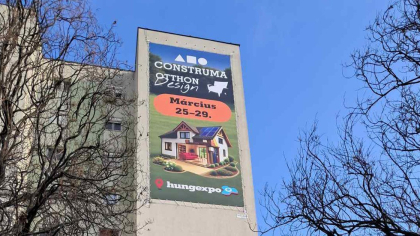



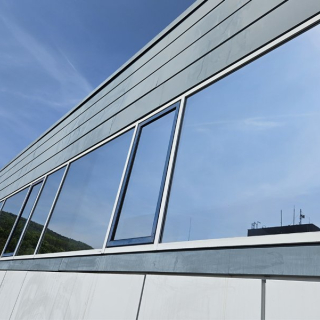

Budapest, Inner City, Monday morning. After several weeks of brainstorming, the first net arrives from MOLINO KFT.'s printing house in Szentendre. 8 industrial climbers, scaffolding erectors, structural locksmiths and a structural engineer inspect the buildings for what was at the time considered an "impossible" deadline project. Everywhere there are decorative friezes, protruding cornices, crumbling lower 3 floors, and not a single good anchoring point…
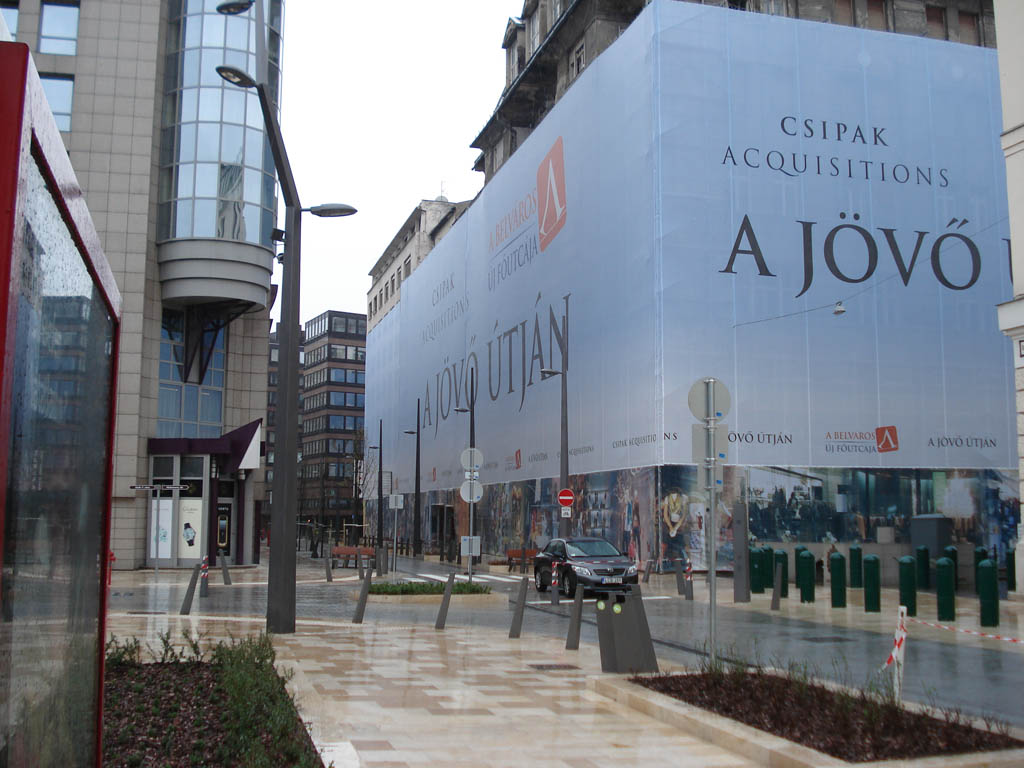
Originally, a large number of support brackets were going to be deployed, but the tight deadline, the uneven surface and safety considerations led to a hybrid solution that had no precedent, especially at this scale. The task was to devise and execute a net covering 3 building blocks – as continuously as possible – in such a way that while the "A" building adjoining the Luxus department store forms a flat surface, the contractor had to work with old surfaces coloured by parapets and "various protruding objects" on the frontages bordered by Bécsi Street, which is being beautified as part of the "Jövő Útján" inner-city renovation programme. The task was further complicated by the fact that, after the renovation, it was not possible to drive cherry-picker vehicles onto the street, meaning the entire installation could only be carried out using alpine techniques.
Although the staff and subcontractors of MOLINO KFT. – as a member of the MRSZ Ambient Division – had encountered bespoke installation projects before, since they specialise in the installation and rental of custom advertising surfaces, the task was a major challenge.
"The installation was made more difficult by the construction deadline set by the Client and the Municipality, which coincided with the street's Sunday handover date, and by the fact that any delay in any sub-process would have jeopardised the entire project's deadline. Due to the uniqueness and scale of the project, the subcontractors also treated the work as their own and delivered the highest level of professionalism expected of them." – said Tibor Tarján, Managing Director of MOLINO KFT., who coordinated the entire installation.
The prints were produced during night shifts. Since the facades were particularly complex, final production could only take place after measurements were taken once the receiving structures, scaffolding and wire frames were completed. It was especially important that the graphic elements and inscriptions did not break apart at the individual turns yet remained proportional, meaning the DTP graphic designer had to sit in front of the computer around the clock.
The advertisement covers more than 3,100 m² of surface area, composed of more than 17 individual pieces; the largest single continuous mesh net was 580 m², while the smallest "cover skirt" was made at just 4 m². A further unique feature was that access to individual shops had to be maintained, so a special roll-up solution was applied on the ground floor section in front of the shops.
Related images: